
FileRise




Quick links: Demo • Install • Docker • Unraid • WebDAV • FAQ
Elevate your File Management – A modern, self-hosted web file manager. Upload, organize, and share files or folders through a sleek web interface. FileRise is lightweight yet powerful: think of it as your personal cloud drive that you control. With drag-and-drop uploads, in-browser editing, secure user logins (with SSO and 2FA support), and one-click sharing, FileRise makes file management on your server a breeze.
4/3/2025 Video demo:
https://github.com/user-attachments/assets/221f6a53-85f5-48d4-9abe-89445e0af90e
Dark mode:
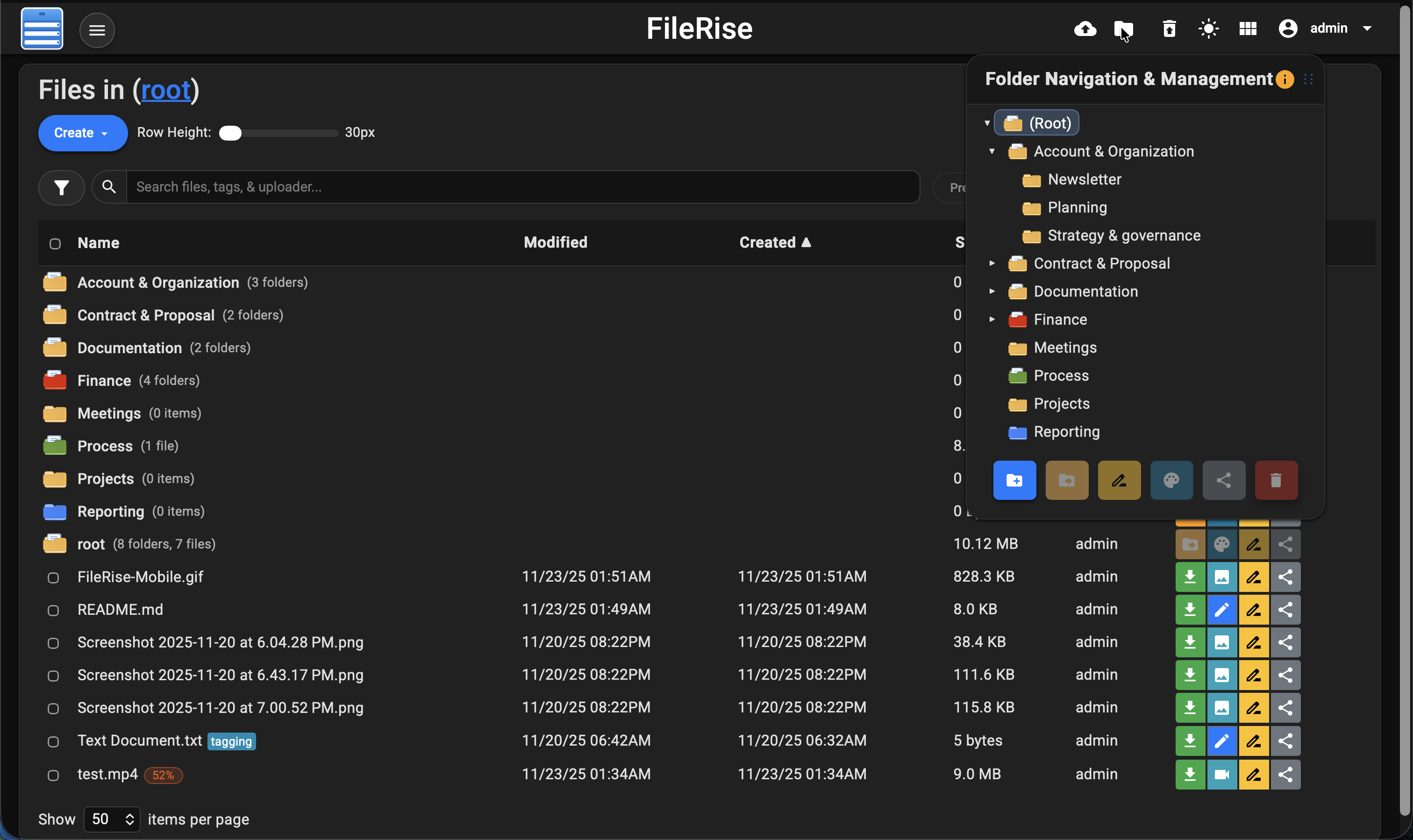
Features at a Glance or Full Features Wiki
-
🚀 Easy File Uploads: Upload multiple files and folders via drag & drop or file picker. Supports large files with pause/resumable chunked uploads and shows real-time progress for each file. FileRise will pick up where it left off if your connection drops.
-
🗂️ File Management: Full set of file/folder operations – move or copy files (via intuitive drag-drop or dialogs), rename items, and delete in batches. You can download selected files as a ZIP archive or extract uploaded ZIP files server-side. Organize content with an interactive folder tree and breadcrumb navigation for quick jumps.
-
🗃️ Folder Sharing & File Sharing: Share entire folders via secure, expiring public links. Folder shares can be password-protected, and shared folders support file uploads from outside users with a separate, secure upload mechanism. Folder listings are paginated (10 items per page) with navigation controls; file sizes are displayed in MB for clarity. Share individual files with one-time or expiring links (optional password protection).
-
🔌 WebDAV Support: Mount FileRise as a network drive or use it head-less from the CLI. Standard WebDAV operations (upload / download / rename / delete) work in Cyberduck, WinSCP, GNOME Files, Finder, etc., and you can also script against it with
curl– see the WebDAV + curl quick-starts. Folder-Only users are restricted to their personal directory; admins and unrestricted users have full access. -
📚 API Documentation: Auto-generated OpenAPI spec (
openapi.json) and interactive HTML docs (api.html) powered by Redoc. -
📝 Built-in Editor & Preview: View images, videos, audio, and PDFs inline with a preview modal. Edit text/code files in your browser with a CodeMirror-based editor featuring syntax highlighting and line numbers.
-
🏷️ Tags & Search: Categorize your files with color-coded tags and locate them instantly using indexed real-time search. Advanced Search adds fuzzy matching across file names, tags, uploader fields, and within text file contents.
-
🔒 User Authentication & Permissions: Username/password login with multi-user support (admin UI). Current permissions: Folder-only, Read-only, Disable upload. SSO via OIDC providers (Google/Authentik/Keycloak) and optional TOTP 2FA.
-
🎨 Responsive UI (Dark/Light Mode): Mobile-friendly layout with theme toggle. The interface remembers your preferences (layout, items per page, last visited folder, etc.).
-
🌐 Internationalization & Localization: Switch languages via the UI (English, Spanish, French, German). Contributions welcome.
-
🗑️ Trash & File Recovery: Deleted items go to Trash first; admins can restore or empty. Old trash entries auto-purge (default 3 days).
-
⚙️ Lightweight & Self-Contained: Runs on PHP 8.3+ with no external database. Single-folder install or Docker image. Low footprint; scales to thousands of files with pagination and sorting.
(For full features and changelogs, see the Wiki, CHANGELOG or Releases.)
Live Demo
demo / demo
Curious about the UI? Check out the live demo: https://demo.filerise.net (login with username “demo” and password “demo”). The demo is read-only for security. Explore the interface, switch themes, preview files, and see FileRise in action!
Installation & Setup
Deploy FileRise using the Docker image (quickest) or a manual install on a PHP web server.
1) Running with Docker (Recommended)
Pull the image
docker pull error311/filerise-docker:latest
Run a container
docker run -d \
  --name filerise \
  -p 8080:80 \
  -e TIMEZONE="America/New_York" \
  -e DATE_TIME_FORMAT="m/d/y  h:iA" \
  -e TOTAL_UPLOAD_SIZE="5G" \
  -e SECURE="false" \
  -e PERSISTENT_TOKENS_KEY="please_change_this_@@" \
  -e PUID="1000" \
  -e PGID="1000" \
  -e CHOWN_ON_START="true" \
  -e SCAN_ON_START="true" \
  -e SHARE_URL="" \
  -v ~/filerise/uploads:/var/www/uploads \
  -v ~/filerise/users:/var/www/users \
  -v ~/filerise/metadata:/var/www/metadata \
  error311/filerise-docker:latest
This starts FileRise on port 8080 → visit http://your-server-ip:8080.
Notes
- Do not use Docker
--user. Use PUID/PGID to map on-disk ownership (e.g.,1000:1000; on Unraid typically99:100). CHOWN_ON_START=trueis recommended on first run. Set to false later for faster restarts.SCAN_ON_START=trueindexes files added outside the UI so their metadata appears.SHARE_URLoptional; leave blank to auto-detect host/scheme. Set to site root (e.g.,https://files.example.com) if needed.- Set
SECURE="true"if you serve via HTTPS at your proxy layer.
Verify ownership mapping (optional)
docker exec -it filerise id www-data
# expect: uid=1000 gid=1000   (or 99/100 on Unraid)
Using Docker Compose
Save as docker-compose.yml, then docker-compose up -d:
version: "3"
services:
  filerise:
    image: error311/filerise-docker:latest
    ports:
      - "8080:80"
    environment:
      TIMEZONE: "UTC"
      DATE_TIME_FORMAT: "m/d/y  h:iA"
      TOTAL_UPLOAD_SIZE: "10G"
      SECURE: "false"
      PERSISTENT_TOKENS_KEY: "please_change_this_@@"
      # Ownership & indexing
      PUID: "1000"              # Unraid users often use 99
      PGID: "1000"              # Unraid users often use 100
      CHOWN_ON_START: "true"    # first run; set to "false" afterwards
      SCAN_ON_START: "true"     # index files added outside the UI at boot
      # Sharing URL (optional): leave blank to auto-detect from host/scheme
      SHARE_URL: ""
    volumes:
      - ./uploads:/var/www/uploads
      - ./users:/var/www/users
      - ./metadata:/var/www/metadata
Access at http://localhost:8080 (or your server’s IP).
The example sets a custom PERSISTENT_TOKENS_KEY—change it to a strong random string.
First-time Setup
On first launch, if no users exist, you’ll be prompted to create an Admin account. Then use User Management to add more users.
2) Manual Installation (PHP/Apache)
If you prefer a traditional web server (LAMP stack or similar):
Requirements
- PHP 8.3+
- Apache (mod_php) or another web server configured for PHP
- PHP extensions:
json,curl,zip(and typical defaults). No database required.
Download Files
git clone https://github.com/error311/FileRise.git
Place the files in your web root (e.g., /var/www/). Subfolder installs are fine.
Composer (if applicable)
composer install
Folders & Permissions
mkdir -p uploads users metadata
chown -R www-data:www-data uploads users metadata   # use your web user
chmod -R 775 uploads users metadata
uploads/: actual filesusers/: credentials & token storagemetadata/: file metadata (tags, share links, etc.)
Configuration
Edit config.php:
TIMEZONE,DATE_TIME_FORMATfor your locale.TOTAL_UPLOAD_SIZE(ensure PHPupload_max_filesizeandpost_max_sizemeet/exceed this).PERSISTENT_TOKENS_KEYfor “Remember Me” tokens.
Share link base URL
- Set
SHARE_URLvia web-server env vars (preferred),
or keep usingBASE_URLinconfig.phpas a fallback. - If neither is set, FileRise auto-detects from the current host/scheme.
Web server config
- Apache: allow
.htaccessor merge its rules; ensuremod_rewriteis enabled. - Nginx/other: replicate basic protections (no directory listing, deny sensitive files). See Wiki for examples.
Browse to your FileRise URL; you’ll be prompted to create the Admin user on first load.
Unraid
- Install from Community Apps → search FileRise.
- Default bridge: access at
http://SERVER_IP:8080/. - Custom br0 (own IP): map host ports to 80/443 if you want bare
http://CONTAINER_IP/without a port. - See the support thread for Unraid-specific help.
Quick-start: Mount via WebDAV
Once FileRise is running, enable WebDAV in the admin panel.
# Linux (GVFS/GIO)
gio mount dav://demo@your-host/webdav.php/

# macOS (Finder → Go → Connect to Server…)
https://your-host/webdav.php/
Finder typically uses
https://(orhttp://) URLs for WebDAV, while GNOME/KDE usedav:///davs://.
Windows (File Explorer)
-
Open File Explorer → Right-click This PC → Map network drive…
-
Choose a drive letter (e.g.,
Z:). -
In Folder, enter:
https://your-host/webdav.php/ -
Check Connect using different credentials, then enter your FileRise username/password.
-
Click Finish.
Important:
Windows requires HTTPS (SSL) for WebDAV connections by default.
If your server uses plain HTTP, you must adjust a registry setting:
Open Registry Editor (
regedit.exe).Navigate to:
HKEY_LOCAL_MACHINE\SYSTEM\CurrentControlSet\Services\WebClient\ParametersFind or create a
DWORDvalue named BasicAuthLevel.Set its value to
2.Restart the WebClient service or reboot.
📖 See the full WebDAV Usage Wiki for SSL setup, HTTP workaround, and troubleshooting.
FAQ / Troubleshooting
-
“Upload failed” or large files not uploading: Ensure
TOTAL_UPLOAD_SIZEin config and PHP’spost_max_size/upload_max_filesizeare set high enough. For extremely large files, you might need to increasemax_execution_timeor rely on resumable uploads in smaller chunks. -
How to enable HTTPS? FileRise doesn’t terminate TLS itself. Run it behind a reverse proxy (Nginx, Caddy, Apache with SSL) or use a companion like nginx-proxy or Caddy in Docker. Set
SECURE="true"in Docker so FileRise generates HTTPS links. -
Changing Admin or resetting password: Admin can change any user’s password via User Management. If you lose admin access, edit the
users/users.txtfile on the server – passwords are hashed (bcrypt), but you can delete the admin line and restart the app to trigger the setup flow again. -
Where are my files stored? In the
uploads/directory (or the path you set). Deleted files move touploads/trash/. Tag information is inmetadata/file_metadata.jsonand trash metadata inmetadata/trash.json, etc. Backups are recommended. -
Updating FileRise: For Docker, pull the new image and recreate the container. For manual installs, download the latest release and replace files (keep your
config.phpanduploads/users/metadata). Clear your browser cache if UI assets changed.
For more Q&A or to ask for help, open a Discussion or Issue.
Contributing
Contributions are welcome! See CONTRIBUTING.md.
Areas to help: translations, bug fixes, UI polish, integrations.
If you like FileRise, a ⭐ star on GitHub is much appreciated!
Community and Support
- Reddit: r/selfhosted: FileRise Discussion – (Announcement and user feedback thread).
- Unraid Forums: FileRise Support Thread – for Unraid-specific support or issues.
- GitHub Discussions: Use Q&A for setup questions, Ideas for enhancements.
Dependencies
PHP Libraries
- jumbojett/openid-connect-php (v^1.0.0)
- phpseclib/phpseclib (v~3.0.7)
- robthree/twofactorauth (v^3.0)
- endroid/qr-code (v^5.0)
- sabre/dav (^4.4)
Client-Side Libraries
- Google Fonts – Roboto and Material Icons (Google Material Icons)
- Bootstrap (v4.5.2)
- CodeMirror (v5.65.5) – For code editing functionality.
- Resumable.js (v1.1.0) – For file uploads.
- DOMPurify (v2.4.0) – For sanitizing HTML.
- Fuse.js (v6.6.2) – For indexed, fuzzy searching.
Acknowledgments
- Based on uploader by @sensboston.
License
MIT License – see LICENSE.